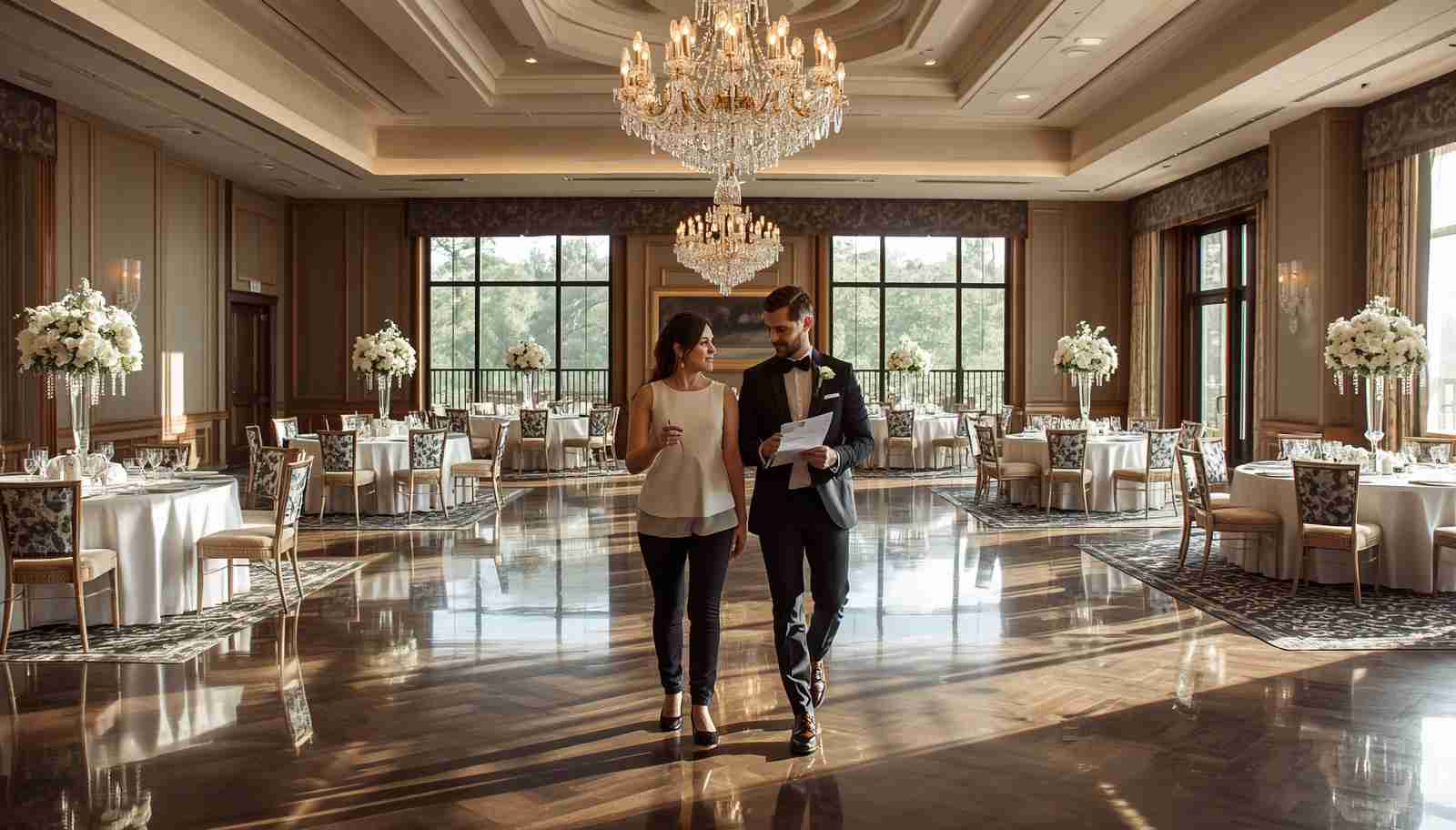
Most venue tours are designed to sell you on the prettiest room, not to show you what your wedding day will actually feel like. The right wedding venue tour questions uncover the operational details that separate a smooth, on-time celebration from a stressful scramble.
If you are touring multiple elegant ballroom spaces in a centrally located Houston venue, focus on the answers you can verify in writing. That is how you compare venues fairly, even when every tour feels “perfect” in the moment.

How To Use This Venue Tour Question List (So You Actually Compare Venues)
A venue tour checklist only works if you treat it like a scoring tool, not a casual conversation. Your goal is to leave each tour with clear numbers, clear policies, and clear responsibility lines.
Bring a written checklist and score each answer (clear, partial, vague) so venues are easy to compare later. A comprehensive wedding planning checklist can also help you organize venue research, budgeting, and vendor decisions.
Ask for answers in writing when possible (proposal, inclusions sheet, sample contract) to avoid memory gaps. A sample contract and an itemized quote are more reliable than anything said during a walkthrough.
Tour at the same time of day as your wedding if you can to see lighting, traffic, and noise conditions. In Houston, the difference between a 2 p.m. and 6 p.m. arrival can change parking flow, photo lighting, and even how hard the climate control has to work.
What To Bring to a Houston Venue Tour
Bring your guest count range, ceremony/reception timeline, and top 3 non-negotiables (indoor ceremony, late end time, open vendor policy). This keeps the conversation focused on fit, not fantasy.
Bring a few inspiration photos plus practical items: measuring tape, phone charger, and a notes template. A measuring tape sounds nerdy until you realize your rectangle tables do not fit the dance floor you imagined.
How To Capture Answers Quickly
Take photos of each space plus key details: restrooms, loading entrance, bridal suite, and parking. These are the details that affect guest comfort and vendor load-in, yet they are easy to forget.
Record exact numbers: hours included, overtime rate, deposit amount, and capacity by layout. If a venue cannot give you exact numbers, that is useful information too.
Availability, Timing, and Schedule Control
Your timeline is only “yours” if the venue’s hours of access, vendor policies, and cleanup rules support it. Many couples discover late in the planning process that venues limit early access or enforce stricter end times than they expected. These venue tour questions help uncover those restrictions before you sign a contract.
Confirm date availability plus hold policy (how long they’ll hold your date and whether holds are free). Ask what happens if another couple requests the same date while you are “thinking about it.”
Ask how many hours are included and what early access looks like for hair/makeup, décor, and vendor load-in. If you need a getting-ready suite early, get the exact time in writing.
Clarify end time, last call, and cleanup deadlines, then ask about overtime pricing. A hard stop plus a high overtime rate can change your entire reception pacing.
Questions That Prevent a Rushed Wedding Day
“What time can vendors arrive, and what time must everyone be out?”
This one question reveals vendor load-in windows, elevator rules, loading dock access, and whether the venue expects a fast teardown.
“Is there a required timeline, or can we build our own with our planner?”
Some venues require a house timeline to protect staffing and simultaneous events. That is not automatically bad, but you should know before you sign.
Pricing, Deposits, and What’s Actually Included
Venue tour questions about pricing go beyond the rental fee. What matters is the total of required staffing, required bar structure, required rentals, and mandatory fees.
Request an itemized quote that separates venue rental, staffing, security, bar, rentals, and service fees. If you are comparing ballrooms, this is the only way to compare apples to apples.
Ask what’s included by default (tables, chairs, linens, getting-ready suites, A/V) vs. add-ons. If a venue says “tables and chairs are included,” confirm quantities, styles, and setup and teardown responsibility.
Confirm deposit amount, payment schedule, and whether payments are refundable or transferable. Ask how the cancellation policy and rescheduling policy work in real scenarios, not just in legal language.
If you want a deeper breakdown of typical local pricing, review this guide to understanding Houston venue pricing and what drives it: a clear explanation of local venue pricing factors.
Hidden-Cost Questions to Ask Up Front
“What fees are mandatory (service charge, admin fee, gratuity, cleaning fee)?”
Ask whether the service fee is a percentage and what it applies to. Confirm whether gratuity is included or expected on top.
“Do you require specific rentals or preferred vendors that add cost?”
Some venues require a preferred vendor list for catering, bar, or security staff. Others allow an open vendor policy but charge coordination or outside-vendor fees.
Contract Clarity Checks
Ask for a sample contract and confirm what triggers additional charges (damage, overtime, extra staff). Then ask who determines staffing needs and when they make that decision.
Confirm insurance requirements and who is responsible for permits (if applicable). Venue tour questions should include liability insurance requirements. Ask what coverage limits vendors must carry and whether the venue requires a certificate of insurance naming the venue as an additional insured.
For a practical checklist of what many venues include versus what becomes an add-on, see this breakdown of what is typically included in a venue rental.
Capacity, Layout, and Guest Comfort
Venue tour questions about capacity matter more than many couples realize. Different room layouts affect whether a seated dinner feels spacious or cramped and whether a cocktail-style reception has enough room for bar lines and mingling.
Ask for capacity by layout (seated dinner, cocktail, ceremony, with dance floor) rather than a single number. A room that “holds 250” may only hold 180 comfortably with a dance floor and band.
Confirm table types and sizes (round vs. rectangle) and what linens/colors are available. If you want long rectangle tables, confirm how many the venue owns versus what you must rent.
Evaluate guest flow: cocktail space, bar lines, restrooms, accessibility, and climate control. A luxury wedding atmosphere is not just chandeliers, it is how the night moves.
Layout Questions That Affect the Vibe
“Where does the dance floor go, and what’s the largest dance floor you can fit?”
A dance floor placed too close to a bar bottlenecks traffic. A dance floor that is too small kills energy.
“Can we flip a room from ceremony to reception, and who handles the flip?”
Room flip plans need staffing, timing, and a place for guests to go during the transition. Ask whether the venue manager coordinates it or if your planner must staff it.
Accessibility and Comfort Considerations
Ask about ADA accessibility, elevator availability (if multi-level), and distance from parking to entrance. If you have older guests, this can matter more than the decor.
Confirm heating/air conditioning performance for a full room and whether doors must stay closed. In Houston heat, a beautiful indoor venue option (weather-proof) only works if the climate control keeps up at full capacity.
Vendors, Catering, and Bar Rules
Venue tour questions about vendor policies can have a major impact on your budget and stress level. They also determine how customizable your event experience can really be.
Clarify whether catering is in-house, required from a list, or open vendor, and what the kitchen setup supports. “Catering included” can mean anything from a full in-house catering program to a required caterer list.
Ask about alcohol policy: in-house bar, BYOB, corkage fees, required bartenders, and last-call rules. Confirm bartender requirements based on guest count, not vague estimates.
Confirm vendor insurance, load-in routes, and whether there are restrictions on candles, confetti, sparklers, or fog machines. If a venue has strict rules, you want them before you design your whole send-off.
Catering Logistics That Can Make or Break Dinner Service
“Is there a prep kitchen, warming kitchen, or full kitchen, and what equipment is included?”
Equipment matters for timing, especially for plated service. Ask about refrigeration, ovens, ice access, and counter space.
“Where do caterers stage bussing, trash, and dishwashing?”
If there is no clear staging plan, service slows down and trash becomes visible. That affects guest experience fast.
Preferred Vendors vs. Open Vendor Policies
Ask if a vendor list is required or recommended, and whether outside vendors pay fees. Then ask if those fees apply to every vendor or only certain categories.
Confirm who coordinates vendors day-of: the venue manager, planner, or catering captain. A venue with a strong day-of contact can prevent small issues from becoming big ones.
If you want more venue-specific prompts for ballroom tours, this resource on smart questions to ask before booking a ballroom pairs well with your checklist.
Weather, Backup Plans, and Houston-Specific Risks
Houston weddings have predictable risks: heat, sudden downpours, and tropical systems. A venue’s backup plan is not a vibe, it is a written workflow with capacity limits.
Ask what happens if weather shifts (heat, heavy rain, tropical systems): indoor ceremony options, covered entrances, and timeline flexibility. If your ceremony space is outdoors, ask where guests wait if rain hits 30 minutes before start time.
Confirm power and internet reliability plus backup options (generator policy, emergency lighting, A/V contingencies). A power outage plan should cover lighting, music, and payment processing at the bar.
Clarify parking and arrival plans for storms (valet options, covered drop-off, shuttle staging). A covered drop-off plus a clear valet plan can save hair, makeup, and moods.
The Two Backup Plans You Want in Writing
Plan A/Plan B room assignments with capacity limits and who decides the switch time. If the Plan B reduces capacity by layout, confirm what changes, like fewer round tables or a smaller dance floor.
Rescheduling language: deadlines, fees, and what counts as a force majeure event. If force majeure is invoked, ask what payments apply to a new date and whether your deposit transfers.
Day-Of Operations: Staffing, Communication, and “What If Something Goes Wrong?”
Venue tour questions often reveal how a venue handles real-world challenges. After hundreds of weddings across the Vanderbilt Ballroom, Madison Ballroom, and Biltmore Ballroom, the most reliable predictor of a low-stress day is how clearly a venue answers “what if” questions.
Ask who your day-of point of contact is and whether that person is on-site the entire event. If your contact leaves at dinner, find out who takes over.
Confirm staffing included: venue manager, security, bartenders, attendants, custodial/cleanup. Security staff is often required by policy or by the city, so confirm whether it is included or billed separately.
Ask the non-obvious questions that predict a low-stress day: vendor cancellation process, incident response, and escalation path. You are not being pessimistic, you are being prepared.
Simultaneous Events and Privacy
“How many events run at the same time on our date, and where are they located?”
Simultaneous events are common in large properties. What matters is whether they share entrances, hallways, restrooms, or parking.
“Do we have exclusive use of entrances, restrooms, parking, and photo areas?”
Exclusive use reduces confusion for guests and prevents photo interruptions. If exclusive use is not included, ask what areas are shared and when.
Problem-Prevention Questions From Hundreds of Weddings
“If a vendor is late or cancels, what’s your process and who makes the call?”
Ask whether the venue has backup staffing resources or recommended replacements. Confirm who communicates with you, your planner, and the vendor team.
“If something breaks or spills, who handles it and what are the fees?”
This ties directly to your cleaning fee, damage clauses, and whether extra custodial labor triggers charges. Ask what “damage” means in the wedding venue contract.
Photo, Sound, and Lighting Considerations (Often Overlooked on Tours)
A ballroom can look perfect at 3 p.m. and photograph completely differently at 7 p.m. Lighting controls and sound rules affect your first dance, your speeches, and your video.
Ask about lighting controls, dimming, uplighting rules, and whether you can pin-spot centerpieces or cake. If the venue has built-in A/V, ask what is included versus rented.
Confirm sound rules: dB limits, band/DJ setup location, curfew ordinances, and microphone availability. If there is a sound system, ask whether it supports your DJ’s mixer or if they must bring their own.
Identify photo priorities: indoor portrait spots, rain photo options, and any restrictions on flash or tripods. If your rain plan is “we will figure it out,” you will feel it on the day.
Questions for Your Photographer and DJ to Answer
Where can the DJ/band load in, and how long does setup take?
This affects your vendor load-in schedule and whether you need early access.
What are the best indoor backdrops if it rains, and are there time limits for photos?
Ask about access to staircases, lounges, and architectural features, plus whether other events can block those areas.
Common Mistakes Couples Make on Venue Tours (And How To Avoid Them)
Couples rarely regret asking hard questions. They regret not asking them until the wedding venue contract is already signed.
Only asking about price and capacity instead of operations, staffing, and contingency plans. A venue can be ideal for small to large guest counts and still be a headache if operations are unclear.
Not verifying what “included” means (quantities, styles, setup/teardown responsibility, and timing). “Tables and chairs” is not enough, you need the exact inventory and who sets it.
Falling in love with a room before checking contract terms, restrictions, and simultaneous events. The tour script should never outrank the written policies.
For a list of pitfalls that show up again and again in Houston, this roundup of common venue-tour mistakes to avoid is worth reading before you visit your next space.
A Simple Decision Framework
Choose the venue that answers operational questions clearly and consistently, not the one with the prettiest tour script. Clarity usually signals strong internal processes.
Prioritize guest comfort and logistics (parking, restrooms, climate control) alongside aesthetics. High-end design and finishes matter, but so does a short restroom line and a cool room at 9 p.m.
FAQ
What questions to ask during a wedding venue tour?
Ask what is included in the venue rental fee, what total mandatory fees apply (service fee, gratuity, cleaning fee), and how many hours of access you get. Then confirm staffing, vendor rules, backup plans for weather and power, and how simultaneous events are handled.
Also ask for a sample contract, an itemized quote, and the exact cancellation policy and rescheduling policy in writing. If the venue requires liability insurance, confirm the certificate of insurance details.
What is the 50 30 20 rule for weddings?
It is a common budgeting guideline that allocates about 50% to the venue, food, and drink. Then 30% goes to priority vendors like photography, music, and attire, with the remaining 20% reserved for extras and a cushion.
Use it as a starting point, not a rule. Houston pricing varies a lot based on guest count, bar structure, and what your venue includes.
What is the 30-5 rule for weddings?
It is often used for planning and guest communication: confirm key details about 30 days out, then re-check final logistics about 5 days before the wedding. That includes vendor arrival times, final headcount, seating plan, and your timeline.
It also pairs well with venue coordination. Thirty days out is a good time to confirm room assignments and your rain plan, while five days out is when you re-confirm vendor load-in and your day-of contact.
How to prep for a wedding venue tour?
Bring your guest-count range, a rough timeline, and must-haves like an indoor venue option or an open vendor policy. Use a venue tour checklist, take photos of key logistics like parking and restrooms, and document exact numbers like deposit, payment schedule, overtime rate, and hours of access.
Ask for a sample contract and a written proposal so you can compare venues later without relying on memory.
A Houston Ballroom Note From Grand Central Houston
If you want a venue built for weather-proof celebrations, Grand Central Houston offers multiple elegant ballroom spaces with flexible event layouts and a luxury wedding atmosphere. Couples typically tour the Vanderbilt Ballroom, Madison Ballroom, and Biltmore Ballroom, then compare how each reception space and ceremony space supports their guest count and timeline.
Getting-ready comfort matters too. Ask to see the Sophie and Elise bridal suites, the Royce Groom’s Lounge, and the vendor load-in route, including loading dock access when applicable.
When you are ready, you can schedule a tour with our team and reserve your date so you can get clear answers, a written proposal, and a plan that fits your day.